Welcome
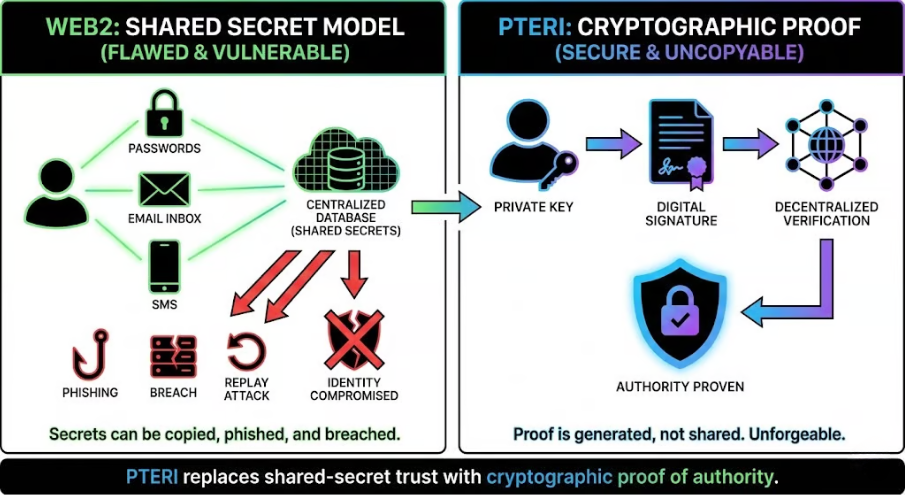
PTERI replaces shared-secret trust — passwords, OTPs, static API keys — with a single primitive: sign, then verify. This is the developer documentation for building on it.
Start here
Account → API key → your first verified call. Copy-pasteable the whole way.
3 minCore ConceptsFive ideas — wallet, signature, verification, authority, settlement. Read this if the rest of the docs feel like jargon.
RouterChoose your pathOrdered reading tracks, one per thing you might be building.
The problem, in three lines
If a secret can be typed, it can be phished. If it can be stored, it can be breached. If it can be forwarded, it can be replayed.
The internet was designed to move information — not value, and not identity. Identity was bolted on later through passwords, SMS codes, and centralized databases: mechanisms that prove what someone knows, never who someone is. PTERI removes the shared secret entirely, so the attacks that depend on one have nothing left to steal.
How these docs are organised
The sidebar follows the order you will actually need things.
| Section | What lives there | Go when you want to… |
|---|---|---|
| Start here | Quickstart, Core Concepts, Choose your path | Orient yourself and make a first call |
| Build | Platform Capabilities, API Reference, SDKs, AI Agents & MCP | Write code against the platform |
| Understand | Foundations, The PTERI Model, Payments & Identity, Comparisons | Know why it is built this way |
| Trust & operate | Architecture & Security, Threat Model, Operations & Scaling | Review the security model, or run it in production |
| Ship | Use Cases, Product & Access | See worked examples and get access |
| Help | FAQs, error messages, status | Something is not working |
How pages are labelled
Not everything here is equally settled. Where a claim has not been confirmed against the published spec or production behaviour, the page says so in place rather than sounding more certain than it is.
| Label | Meaning |
|---|---|
| Confirmed | Verified against the published OpenAPI spec or production behaviour. |
| Product concept | Architecture-level explanation. Implementation detail intentionally left out. |
| Needs verification | Documented, but the exact route, schema, or limit still has to be confirmed by engineering. |
Every "Needs verification" chip links to the Unverified tag index, and the Verification Queue collects every open item in one prioritised list — search for unverified to find either.